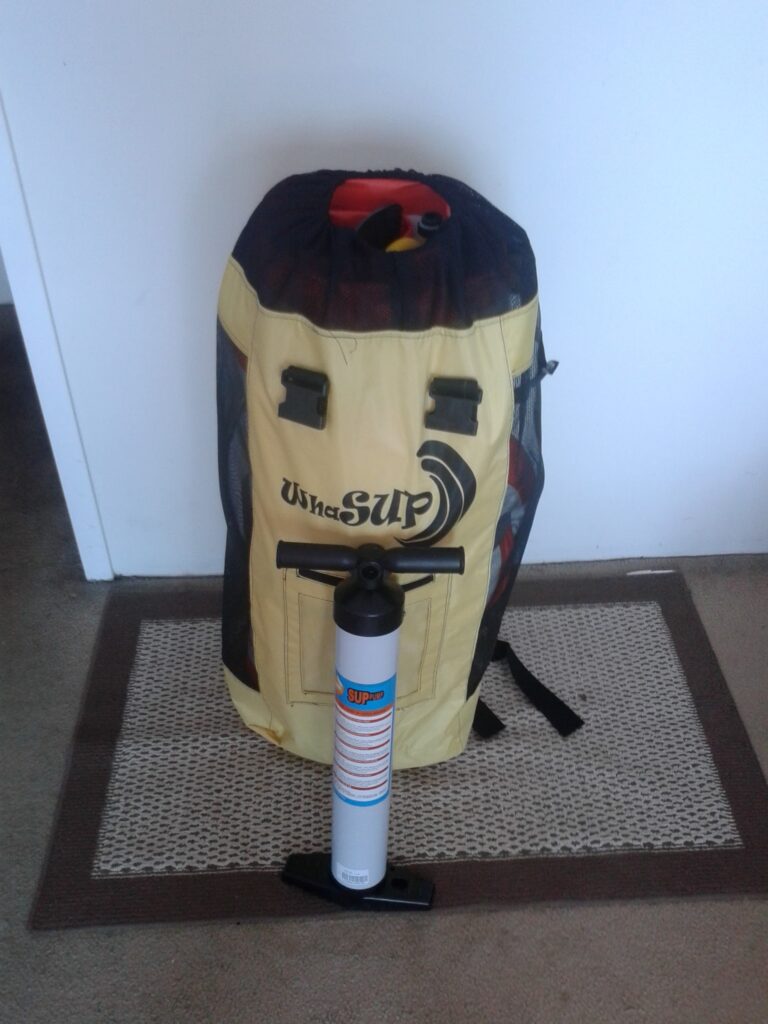
Paddle boarding became part of my outdoor exploration in Vancouver in 2014, when I bought an inflatable stand-up paddle board and began taking it to the beaches and waterways around the city. Its portability made the experience particularly accessible: I could carry the deflated board on my back, walk to the water, inflate it at the beach, and begin exploring.
What started as learning how to balance, paddle, and control the board gradually developed into much more ambitious trips. Falling into the cold ocean was simply part of the learning process, and I enjoyed the trial and error involved in becoming more comfortable on the water. As my experience grew, so did the distances I was willing to explore and the variety of conditions and routes I encountered.
Most of my paddle boarding took place around Vancouver, including English Bay, False Creek, Kitsilano, Jericho Beach, Stanley Park, Vancouver Harbour, and Coal Harbour. Some outings became long-distance adventures, while others gave me experiences that would have been impossible to reproduce from land. Among the most memorable were paddling around Vancouver and watching the city’s summer fireworks at night from the water.
This archive documents that concentrated period of exploration, primarily in 2014 with a return to paddle boarding in 2016. Together, the trips capture how a portable inflatable board became a way for me to experience Vancouver from an entirely different perspective.
My Paddle Boarding Journey
My paddle boarding journey began in June 2014 with an inflatable stand-up paddle board and a simple idea: use Vancouver’s access to the ocean to explore the city and its surroundings in a new way. The inflatable design became an important part of how I approached the activity. Instead of needing to transport a full-size solid board, I could carry the deflated SUP like a backpack, walk to the beach, inflate it beside the water, and start paddling.
Learning to use the board was part of the enjoyment. Balance, steering, dealing with waves, and becoming comfortable standing on the board all involved trial and error. The consequences of many early mistakes were fairly simple: I would lose my balance, fall into the cold ocean, climb back onto the board, and try again. Rather than making the activity frustrating, those experiences made learning it more enjoyable.
As I gained experience, paddle boarding changed from learning how to stay on the board into learning what I could actually do with it. My outings became longer and more adventurous, taking me through English Bay, False Creek, Kitsilano, Jericho Beach, around Stanley Park, and eventually into Vancouver Harbour. The same inflatable board that I could carry to the beach on my back became a platform for trips extending many kilometres across Vancouver’s coastal waters.
Most of this journey was concentrated in the summer of 2014, when paddle boarding became one of my main forms of outdoor exploration. I returned to it again in 2016, including another opportunity to experience Vancouver’s summer fireworks from the water. Looking back, the progression from repeatedly falling into the ocean while learning to completing long and challenging routes is one of the things that made this period particularly memorable.
Exploring Vancouver from the Water
Paddle boarding gave me a perspective on Vancouver that was very different from experiencing the city on foot or from its streets. Places that were familiar from land became part of a connected coastal landscape once I was on the water, and the shoreline itself became a route for exploration.
My trips took me through areas such as English Bay, False Creek, Kitsilano, Jericho Beach, Stanley Park, Vancouver Harbour, and Coal Harbour. From a paddle board, these were not simply separate destinations on a map. I could travel between them across the water, follow the coastline, move around familiar landmarks, and see Vancouver’s beaches, parks, downtown skyline, bridges, and harbour from an entirely different angle.
The inflatable SUP also gave me considerable freedom in deciding where an exploration could begin and end. Because I could carry the board on my back, I did not necessarily have to return to the same beach where I had started. I could plan a route through the water, finish somewhere else, deflate the board, pack it up, and continue home on land. That flexibility eventually made some of my more ambitious point-to-point adventures around Vancouver possible.
What I enjoyed most was that the ocean was not merely the setting for the activity—it became part of how I explored the city. Distance, coastline, changing water conditions, views from offshore, and the process of travelling between familiar places under my own power transformed paddle boarding into much more than going to the beach for a short recreational outing. It became another way of discovering Vancouver.
Calculated Exploration
As my paddle boarding trips became longer and more ambitious, planning became an increasingly important part of the experience. Exploring Vancouver’s coastal waters on a stand-up paddle board was very different from following a fixed trail on land. The conditions around me could directly affect whether a planned route remained manageable.
Before setting out, I would consider the route I wanted to follow together with the wind direction, waves, water conditions, and direction of travel. These factors mattered because a route that seemed reasonable on a map could become considerably more difficult when paddling against unfavorable wind or encountering stronger waves. The farther I planned to travel, the more important it became to think about those conditions before getting onto the water.
This created an interesting contrast with the way I initially learned paddle boarding. During shorter outings, losing my balance and falling into the cold ocean could simply be part of the fun and trial-and-error process. On longer trips through more challenging sections of Vancouver’s coastal waters, however, I needed to approach the activity differently. I still wanted to explore and challenge myself, but I wanted those challenges to be calculated rather than careless.
For me, that became part of the attraction. The challenge was not simply to paddle farther. It was to understand the route, evaluate the conditions, choose a direction that made sense, and then use the skills I had developed to complete the journey. Some of my most memorable paddle boarding experiences came from pushing the boundaries of where I could explore while remaining conscious of the environment around me.
My longest and most exciting trip in August 2014 became the clearest example of this approach. It took me beyond the more familiar waters of English Bay and around Stanley Park into a section where waves, wind, and marine traffic created a much greater challenge—and where the experience I had developed during the summer became particularly important.
Around Vancouver by Paddle Board
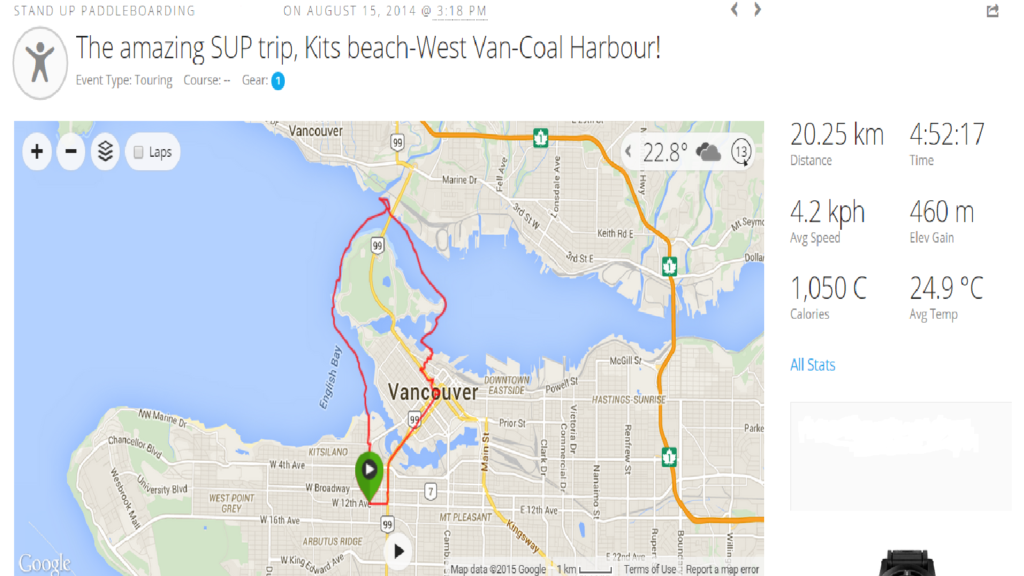
On August 15, 2014, I completed what became my most exciting paddle boarding adventure in Vancouver. The full recorded journey covered 20.25 km (12.6 miles), combining a long paddle around some of Vancouver’s most recognizable waterfront with the return home on land that completed the loop.
I started from home carrying my inflatable paddle board and made my way to Vanier Park on English Bay. After inflating the board and getting onto the water, I headed out through English Bay and began making my way around Stanley Park. Unlike many of my earlier outings, this was not simply a paddle along a familiar stretch of beach. The route was taking me around a major part of Vancouver’s coastline and toward waters that presented a considerably greater challenge.
The most difficult part came as I approached the First Narrows and Lions Gate Bridge area from the west. The waves and wind made controlling the paddle board more demanding, while the presence of large ships moving through Burrard Inlet added another element that I had to remain aware of. This was exactly the kind of situation where the planning, judgment, and experience I had developed over the summer mattered.
One detail I particularly remember is that, despite the challenging conditions, I did not fall into the water even once during the entire paddle. Earlier in the summer, falling into the ocean had been a regular and enjoyable part of learning. Completing this much more demanding journey without a single fall gave me a clear sense of how much my balance, control, and confidence on the board had developed.
After passing through the challenging section around the First Narrows, I continued into Vancouver Harbour, paddling along the northern side of downtown before eventually reaching Coal Harbour. That is where I ended the paddle boarding portion of the adventure, packed up my inflatable SUP, and returned home on land to complete the recorded loop.
The trip brought together many of the things I enjoyed most about paddle boarding: exploration, physical challenge, route planning, changing conditions, and the ability to move through Vancouver in a way that would have been impossible from land. More than a decade later, it remains the paddle boarding journey I remember as my most exciting.
Paddling into the Vancouver Fireworks
Some of my most memorable paddle boarding experiences were not about travelling the greatest distance or completing the most difficult route. They came from taking my paddle board into English Bay at night to watch Vancouver’s summer fireworks from the water.
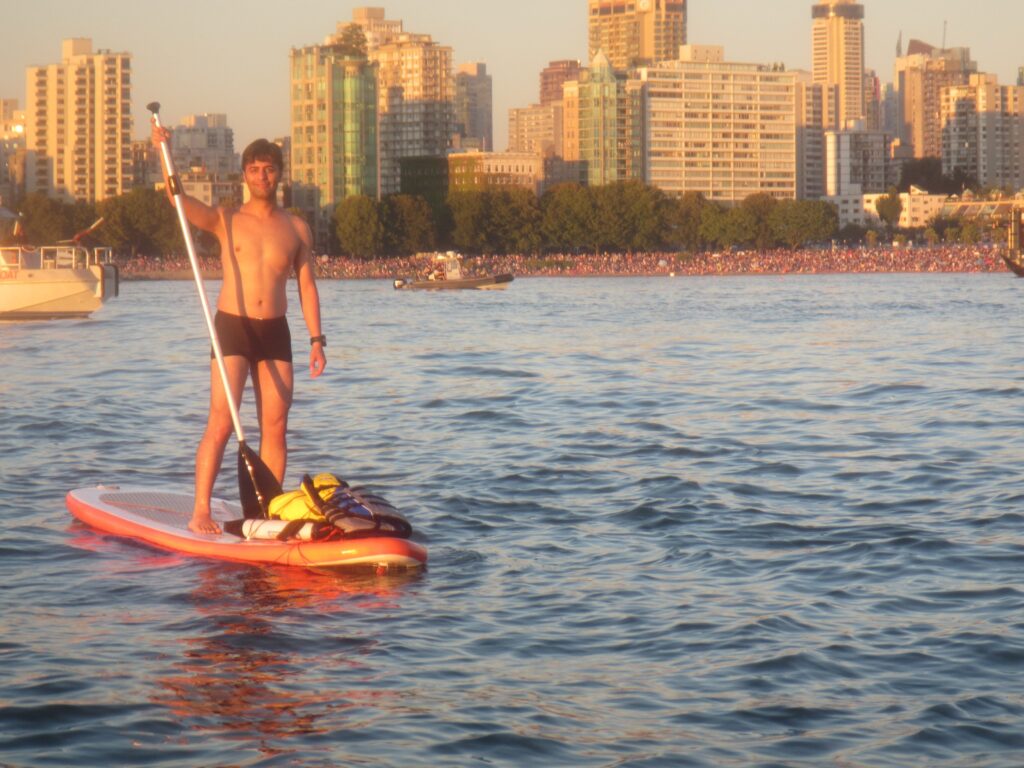
In 2014, I paddled out for all three nights of the Vancouver fireworks. Instead of joining the crowds watching from the beaches and shoreline, I entered English Bay on my SUP and made my way toward the viewing area on the water. The fireworks were launched from a barge in the bay, with boats gathering around the surrounding area to watch the show.
Being there on a stand-up paddle board made the experience particularly special. I was not watching from a large boat or from somewhere along the shore; I was sitting directly on a board at the surface of the ocean, surrounded by the darkness of the water, the lights of Vancouver, the nearby boats, and the fireworks overhead. From that perspective, the scale and atmosphere of the show felt completely different.
There was also something remarkable about using such a simple and portable piece of equipment to reach that experience. The same inflatable paddle board that I could carry to the beach on my back allowed me to paddle out into English Bay and find myself among the closest spectators on the water to one of Vancouver’s largest summer events.
I enjoyed those nights enough that when I returned to paddle boarding in 2016, I went back onto the water for the fireworks again. Of all my SUP experiences, these nights remain the most joyful in my memory—not because they were the longest or most challenging, but because they combined paddle boarding, Vancouver, the ocean at night, and the fireworks into an experience that I could never have had in quite the same way from land.
Paddle Boarding Reports
The paddle boarding reports below document the individual trips behind this chapter of my outdoor exploration. Most come from my concentrated period of paddle boarding in 2014, with additional experiences from my return to the water in 2016.
Together, the reports trace my routes through English Bay, False Creek, Kitsilano, Jericho Beach, around Stanley Park, Vancouver Harbour, Coal Harbour, and other parts of Vancouver’s waterfront. They include everything from shorter outings and early experiences on the board to longer journeys, nighttime fireworks paddles, and the more ambitious routes I attempted as my experience grew.
The reports preserve the details behind those experiences through photographs, dates, distances, recorded routes, times, and Garmin activity data where available. Looking through them now provides a record not only of where I paddled, but also of how quickly the activity progressed from learning on an inflatable SUP to using it as a way to explore Vancouver from the water.
Explore the paddle boarding reports below to follow the individual routes, photographs, and experiences from my 2014 and 2016 SUP adventures.